1. Understanding Nocturnal rMSSD and Parasympathetic Tone
Heart Rate Variability (HRV) is not a measure of cardiovascular fitness; it is the ultimate proxy for the adaptability and resilience of your autonomic nervous system. Modern high-end wearables—like Garmin and Oura—utilize photoplethysmography (PPG) optical sensors that sample blood volume changes at hundreds of times per second to detect the exact milliseconds between your systolic heartbeats. These are your Inter-Beat Intervals (IBIs).
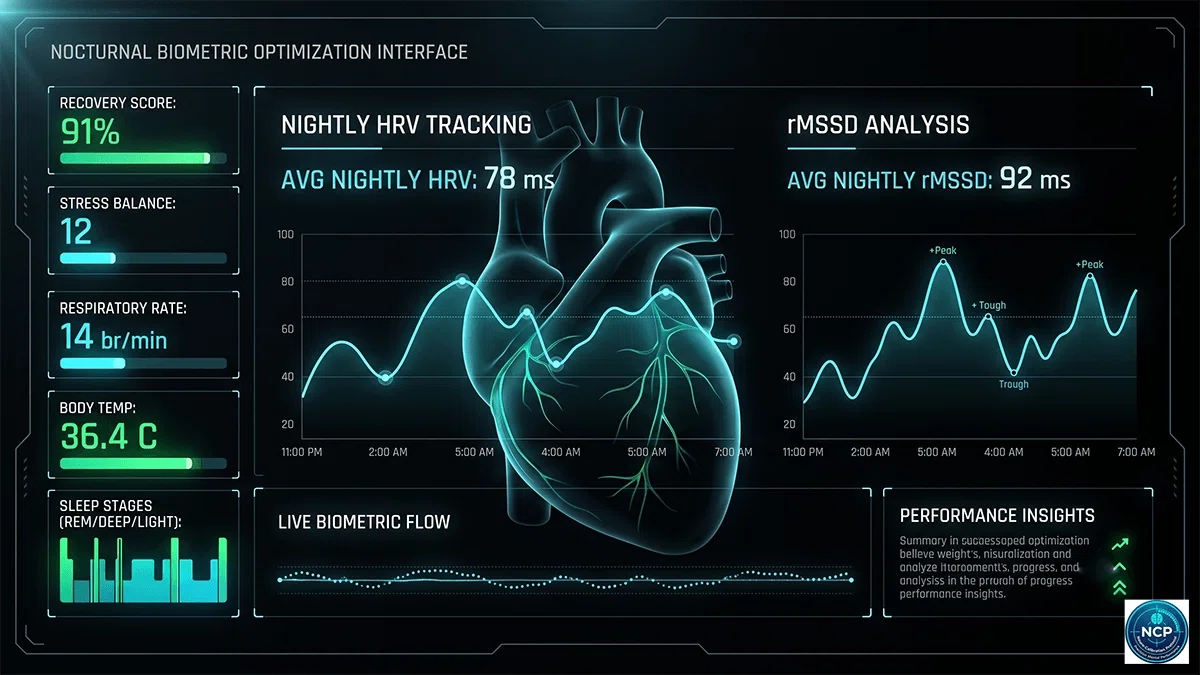
When you wake up to an HRV score, you are typically looking at your rMSSD (Root Mean Square of Successive Differences). Mathematically, rMSSD is calculated by measuring the time variance between adjacent heartbeats—a metric frequently utilized in autonomic function assessments by leading institutions like Johns Hopkins Medicine—squaring those differences, averaging them, and taking the square root.
Why is rMSSD the biohacker's gold standard? Unlike SDNN (Standard Deviation of NN intervals), which reflects broad 24-hour fluctuations and heavy sympathetic (stress) drivers, rMSSD isolates high-frequency parasympathetic modulation. It is a pure, unfiltered look at your vagal tone. When your rMSSD is suppressed, your physiological brake pedal (the vagus nerve) is failing to engage. Your body is surviving, not recovering. To explore the deeper autonomic mechanisms, review our comprehensive clinical guide on autonomic pacing and science.
2. The Physiological Triggers of Suppressed HRV Scores
A sudden "Unbalanced" or "Strained" warning on your Garmin display is not a random glitch. Clinical studies cataloged in PubMed Central demonstrate that nocturnal rMSSD depression correlates directly with acute metabolic and neurological stressors. If your scores are tanking, audit these three biological thieves:
- Late Glycemic Load & Digestive Debt Consuming heavy carbohydrates, high-protein, or hyper-caloric meals within 3 hours of sleep forces your digestive system to work overtime. This metabolic friction triggers an insulin spike that actively blunts the nocturnal release of Human Growth Hormone (HGH). Furthermore, the mechanical act of digestion draws heavy blood flow to the splanchnic circulation (the gut), forcing your nocturnal resting heart rate (RHR) to remain artificially elevated. An elevated heart rate mechanically suppresses your HRV, destroying the first half of your sleep architecture.
- Alcohol and Xenobiotic Metabolism Alcohol is an autonomic wrecking ball. The hepatic (liver) oxidation of ethanol via the alcohol dehydrogenase enzyme requires massive metabolic resources, triggering an acute sympathetic stress response. Even a single glass of premium wine destroys REM sleep architecture and effectively paralyzes vagal down-regulation. Until the ethanol and its toxic byproduct, acetaldehyde, are cleared from the bloodstream, your rMSSD will remain flatlined.
- Cognitive Rumination & High-Beta Lock Engaging in high-stakes professional problem-solving or screen exposure right before bed locks your brainwaves into High-Beta (15-30 Hz) frequencies. This cognitive friction keeps the amygdala hyper-aroused, flooding your endocrine system with cortisol. When the primitive brain perceives a threat—even an abstract one like an unresolved spreadsheet—it chemically blocks the neurological transition into the restorative theta and delta slow-wave sleep phases.
3. Corrective Somatic Protocols for Fast Baseline Restoration
When your wearable flags a suppressed status, cognitive rest alone is insufficient. You cannot simply "relax" or think your way out of a physiological sympathetic loop. To drive your rMSSD back up, you must implement Bottom-Up regulation—using physical, somatic inputs to force the brainstem into submission.
The most clinically proven method is 0.1Hz Resonance Frequency Breathing (approximately 5.5 to 6 breaths per minute). When this precise respiratory cadence is coupled with structured low-frequency acoustic pacing, it mechanically forces your cardiovascular system into a state called Respiratory Sinus Arrhythmia (RSA).
During RSA, your heart rate predictably accelerates on the inhale and decelerates on the exhale. This rhythmic oscillation acts as a massive physical lever on the vagus nerve, rapidly shifting autonomic balance back toward parasympathetic dominance. Research published in Nature Scientific Reports highlights that this specific intervention can lower cortisol and dramatically spike HRV within minutes. For immediate tactical intervention when metrics drop, deploy our audio-guided calibration protocols.
4. Integrating Wearable Data: The 21-Day Baseline Protocol
To effectively biohack your daily executive performance, you must treat your Garmin or Oura data as a dynamic feedback loop rather than a rigid daily grade. Academic reviews hosted on NCBI databases emphasize the danger of neuro-anxiety caused by obsessing over a single anomalous low night.
The professional biohacker's gold standard is tracking your 7-day rolling average against your 21-day historical baseline. Your baseline represents your true physiological capacity.
- Green Zone: 7-day average is within 5% or above your 21-day baseline. You are primed for high-intensity cognitive output, heavy physical training, and aggressive decision-making.
- Amber Zone: 7-day average drops 5-10% below the baseline. This is your warning flag. Enforce a strict digital curfew, eliminate afternoon caffeine, and mandate a 15-minute acoustic vagal reset before sleep.
- Red Zone: 7-day average is consistently >10% below baseline. You are in systemic deficit. Cancel non-essential meetings, deload physical training, and prioritize Slow-Wave Sleep recovery above all other metrics.
*Note: Consumer smartwatches are wellness tools. Chronic, unexplained drops in HRV accompanied by systemic fatigue, chest discomfort, or sleep disturbances warrant professional clinical evaluation to rule out underlying pathologies.