1. The Trap of Top-Down Cognitive Control
Founders and executives often attempt to logic their way out of chronic fatigue. When deadlines mount, runway shortens, and revenue targets loom, the default corporate reflex is to double down on mental effort—working longer hours, micro-optimizing calendars, and attempting to brutally "push through" the exhaustion. This approach relies on top-down cognitive control, a mechanism entirely dependent on the prefrontal cortex (PFC).
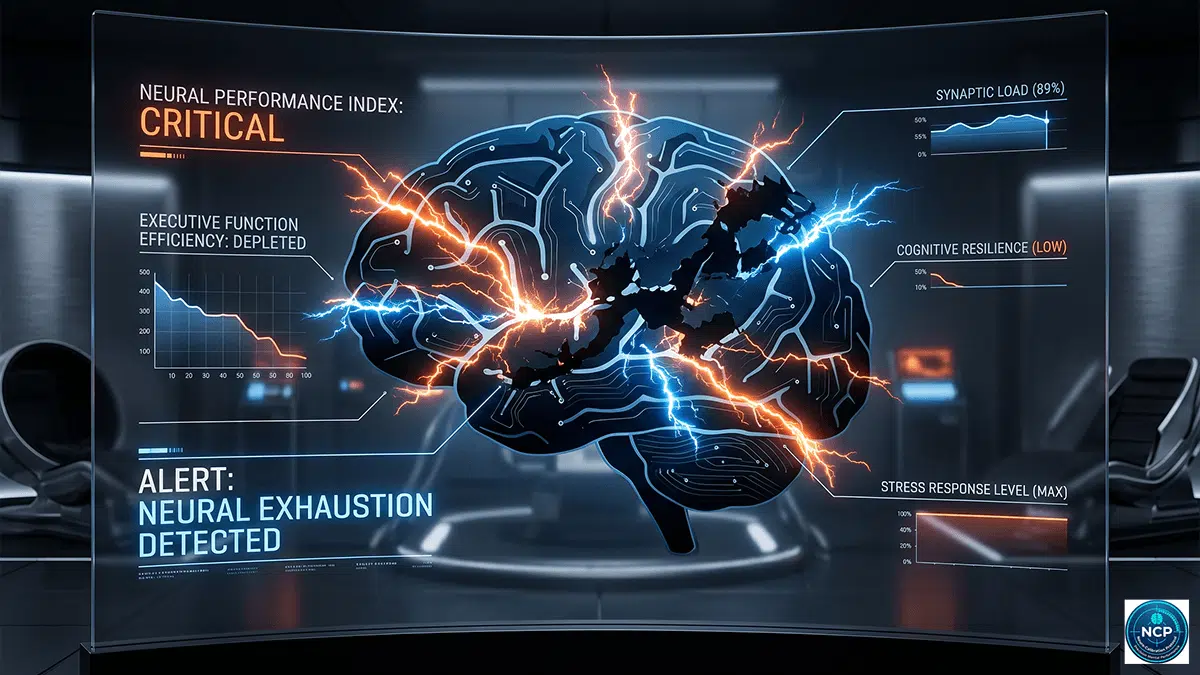
The biological flaw in this strategy is that under chronic, unmanaged stress, high circulating cortisol levels actively shunt glucose and oxygen away from the prefrontal cortex, redirecting metabolic resources toward the amygdala (the brain’s survival center). Clinical literature cataloged via PubMed Central indicates that when the nervous system is trapped in chronic fight-or-flight, your executive command center literally undergoes cellular energy starvation.
You experience this localized starvation as executive dysfunction. It manifests as a severe degradation in working memory, an inability to sequence complex tasks, and a sudden, paralyzing drop in risk-tolerance. Relying on top-down cognitive control during burnout is akin to steering a vehicle with a destroyed transmission by simply shouting at the steering wheel. To understand the underlying physiology of this breakdown, review our core paper on autonomic pacing and science.
2. The Physiological Cost of Sympathetic Overdrive
True founder burnout is not merely "feeling tired"; it is a systemic downregulation of autonomic flexibility resulting from massive Allostatic Load. Allostatic load refers to the cumulative, physical wear-and-tear placed on your biology when it is forced to constantly adapt to high-stakes, high-stress environments.
When you operate for months in sympathetic overdrive, your Hypothalamic-Pituitary-Adrenal (HPA) axis becomes profoundly dysregulated—a neurological feedback loop thoroughly analyzed by neuro-endocrinology experts at Johns Hopkins Medicine. You accrue what clinicians term "endocrine debt." According to medical insights published by Harvard Health Publishing, prolonged exposure to adrenaline and cortisol aggressively suppresses the immune system, triggers systemic inflammation, and accelerates cellular aging.
Crucially for high-performers, this chronic state permanently suppresses Heart Rate Variability (HRV) if left unmanaged. A collapsed HRV means your nervous system has lost its shock absorbers; it can no longer transition smoothly between intense focus and restorative rest. No amount of motivational philosophy, mindset shifting, or productivity hacks can reverse a biological endocrine debt without directly addressing the physical receptors governing stress recovery.
3. Somatic Vagal Pacing as the Ultimate Reset
Because your prefrontal cortex is compromised during burnout, you cannot think your way out of a biological panic loop. Recovery requires bottom-up intervention. You must bypass the conscious, analytical mind and communicate directly with the brainstem.
By stimulating the vagus nerve—the primary superhighway of the parasympathetic nervous system—founders can instantly apply a biological brake to the sympathetic threat response. Research documented in clinical journals via NCBI databases confirms that somatic rhythmicity acts as a direct, physical override switch for acute neural friction.
When you combine specific mechanical breathing patterns (such as prolonged exhalations) with structural low-frequency audio pacing, you send an immediate "retro-signal" to the brainstem. This signal definitively informs the amygdala that the environment is safe, forcing an immediate cessation of the cortisol and adrenaline drip. Instead of waiting for an annual vacation to reset your baseline, structured acoustic protocols allow you to recalibrate your autonomic tone in under 7 minutes.
4. The Founder's Playbook: Building Autonomic Resilience
Modern leaders aiming to biohack their longevity cannot afford to ignore neural recovery. Studies published in Nature Scientific Reports emphasize that high autonomic flexibility correlates directly with superior crisis management, creative problem-solving, and emotional regulation under intense pressure.
Overcoming burnout permanently requires shifting from reactive crisis management to proactive autonomic maintenance. For the high-performing executive, this translates into a two-step daily playbook:
-
Track Morning HRV as a Bandwidth Predictor: Utilize wearables like Oura or Garmin to measure your morning rMSSD (HRV). A suppressed score indicates high allostatic load and diminished cognitive bandwidth. Use this objective data to dictate your risk-taking and meeting density for that specific day.
-
The Systematic Mid-Day Somatic Reset: Do not let sympathetic tension compound until 6 PM. Deploy a 5-minute vagal pacing audio session (like Protocol 01) mid-day to clear adenosine backlogs and reset the nervous system, preventing the slide into clinical burnout.